Architecture
Agent WebUI is the browser and same-origin presentation boundary for GraphOS. It renders runtime capabilities; it does not duplicate their authorities.
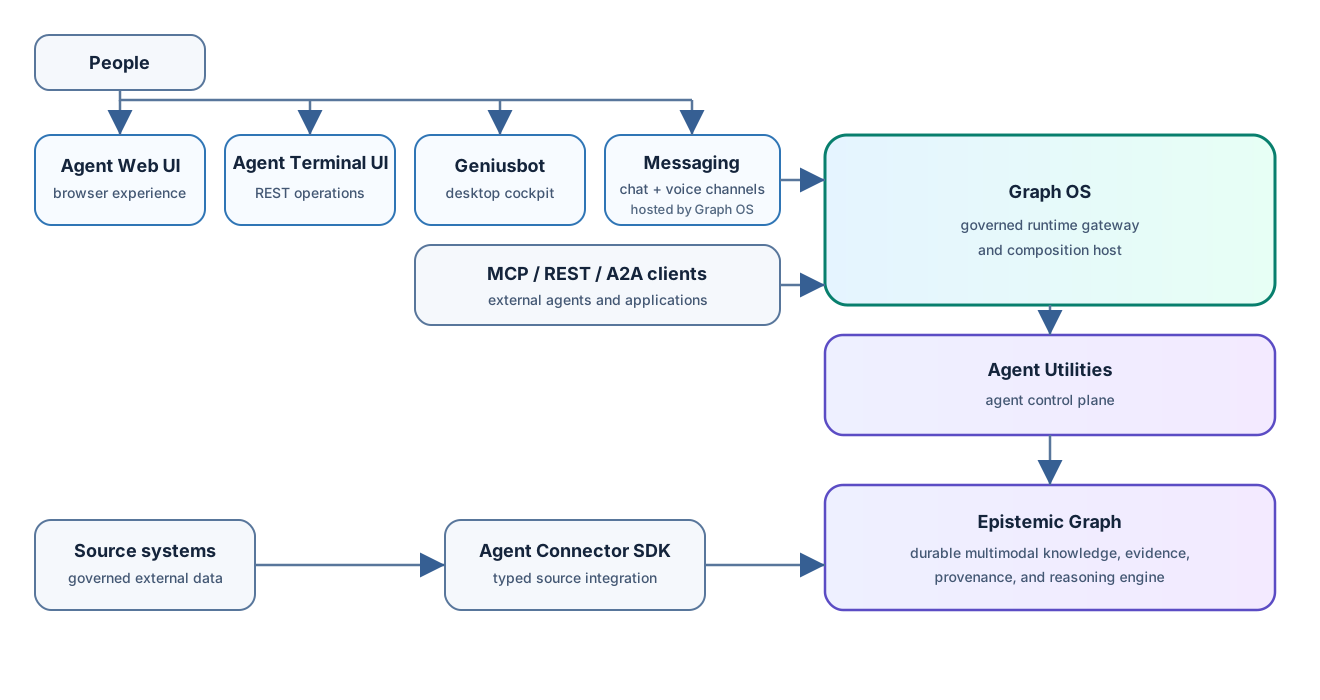
Runtime composition
GraphOS starts Agent WebUI as a supervised co-service when ENABLE_WEB_UI=true.
The composition path is explicit:
- GraphOS creates the native gateway application and verified process context.
- The GraphOS WebUI host creates the Agent WebUI FastAPI application.
- GraphOS injects its gateway route composer through
ApplicationComposer. - Agent WebUI mounts the single-page application after every typed API route.
- Security and observability middleware wrap the complete application.
The standalone Agent WebUI server deliberately omits GraphOS-owned routes. Use the GraphOS-hosted composition for the complete platform surface.
Browser request path
-
Browser
React sends same-origin HTTP, SSE, AG-UI, ACP, or browser-control requests to the WebUI host.
-
WebUI host
FastAPI validates browser boundaries and converts UI intent into a typed, server-side operation.
-
GraphOS
The injected gateway verifies identity, applies runtime policy, and delegates to the owning service.
-
Owned authority
Agent, graph, or connector code executes the operation and returns typed evidence and receipts.
Authority boundaries
| Boundary | Owns | Does not own |
|---|---|---|
| React application | Presentation, interaction state, route metadata, accessibility | Service credentials, policy truth, durable graph state |
| Agent WebUI FastAPI host | Same-origin browser endpoints, SPA serving, host checks, request bounds, CSP | GraphOS fleet lifecycle or graph-engine implementation |
| GraphOS composition | Verified identity, public routing, runtime policy, fleet supervision, injected gateway routes | Agent reasoning, durable knowledge, vendor-specific transport |
| agent-utilities | Agent decisions, workflows, evaluation, skills | Public gateway hosting or database semantics |
| epistemic-graph | Durable data, reasoning, provenance, transactions | Agent orchestration or browser presentation |
| Connector services | Authorized source reads and writes through SDK contracts | Global policy or graph authority |
Identity and credentials
The browser never receives a GraphOS service bearer. The WebUI host terminates the browser session, derives the request actor from the verified server context, and uses host-injected delegation ports for privileged operations. Role metadata affects navigation, but the server remains authoritative for every permission decision.
A local loopback deployment can run without SSO and resolves to the documented single-operator posture. A configured OIDC deployment verifies the session and maps its realm roles to the WebUI role ladder before a protected route renders.
Streaming and activity
AG-UI is the primary conversation stream. ACP sessions use the same composed agent runtime, and WebUI event components render specialist routing, parallel activity, tool invocations, approvals, and sources from typed runtime events. Conversation history combines server-owned records with per-user local presentation state.
Knowledge workspace
Atlas is the shared entry point for graph, RDF, schema, object, table, document, code, and memory exploration. Each view uses the same GraphOS-injected request context. Query and reasoning semantics remain in epistemic-graph; the browser selects a view and renders the returned typed result.
Contact boundary
POST /api/contact accepts only bounded contact fields and a client
idempotency key. It requires an authenticated actor and exact same-origin
request. Delivery is available only when the host injects an adapter with a
durable idempotency fence, deployment-wide abuse control, a fixed destination,
and an explicit retention decision. Successful delivery returns only an opaque
receipt.