Knuckles Team agent platform
Coordinate SI agents without blurring system boundaries
Agent Utilities is the Python control plane for model selection, skills, teams, workflows, governed execution, evaluation, and outcome-driven improvement.
Build an agent
Create a provider-aware agent, attach typed tools and reusable skills, and run it through one governed harness.
Create the operator's first agent →Coordinate work
Route goals through planners, teams, durable loops, budgets, checkpoints, approvals, and observable execution.
Understand orchestration →Operate the control plane
Configure identity, policies, providers, health checks, metrics, and deployment profiles without embedding environment secrets.
Choose a deployment →Runtime map
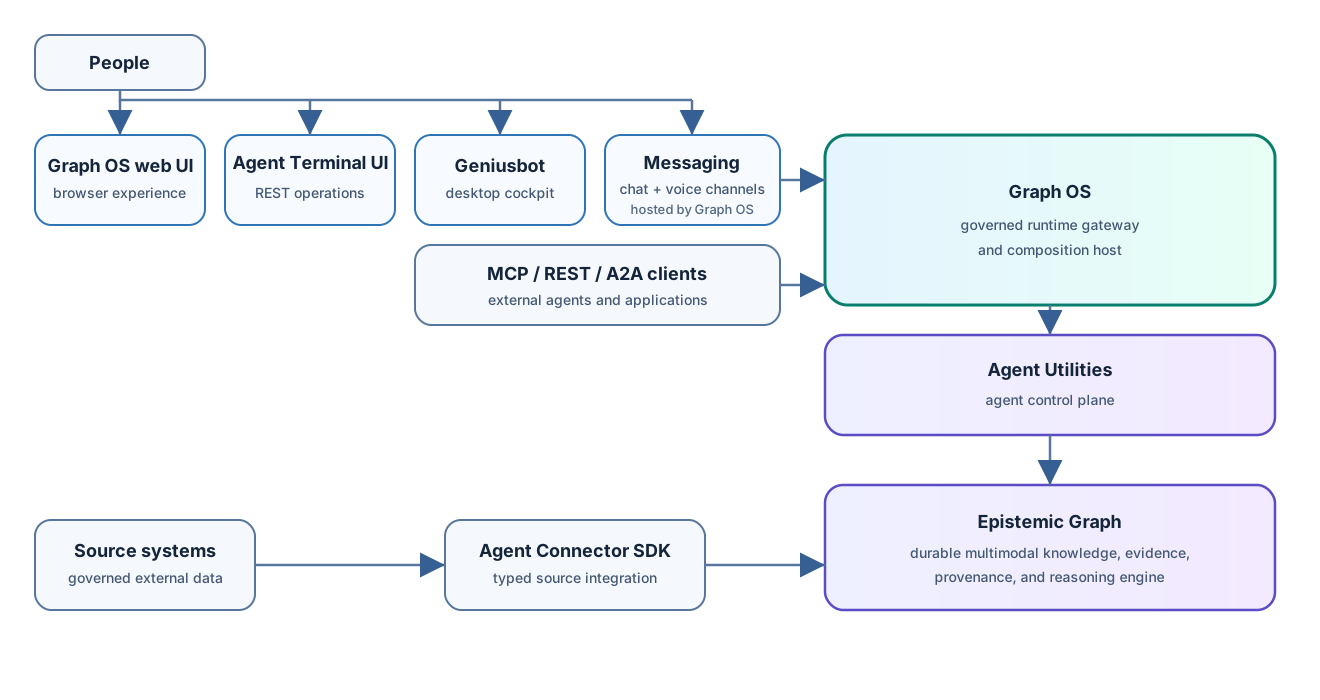
Agent Utilities occupies the agent-control boundary in the shared runtime. It coordinates model and worker activity, reads and writes committed state through Epistemic Graph contracts, and is exposed to clients through GraphOS. Connector adapters reach external systems through the Agent Connector SDK, while Agent WebUI presents the browser experience.
One contract at each boundary
The control plane does not become a second graph engine, public gateway, connector framework, or frontend. Typed contracts keep each authority independently testable and replaceable.
How work moves
- Admit a goal. GraphOS authenticates the caller and passes a scoped request into the control plane.
- Compile context. Agent Utilities selects models, skills, tools, and bounded graph evidence for the task.
- Run under policy. Planners, agents, teams, and workflows operate within budgets, approvals, and safety constraints.
- Commit and learn. Outcomes, traces, and approved state changes return through authoritative contracts for replay and evaluation.
Explore the platform
| I want to… | Start here |
|---|---|
| Install and run a local evaluation | Quick start |
| Build an agent in Python | Creating an agent |
| Choose library, service, or remote consumption | Consumption models |
| Understand control-plane internals | Architecture |
| Configure a deployment | Deployment configurations |
| Operate and observe the runtime | Observability and usage |
| Browse generated Python APIs | API reference |
| Check what ships in this release | Status |
Using the whole ecosystem?
Start with GraphOS for the composed public runtime. Use these Agent Utilities docs when the operator are building or extending agent behavior inside that runtime.
Control-plane capabilities
The implementation is organized around five practical areas rather than one monolithic agent loop:
- Agent runtime — model providers, structured output, toolsets, skills, and guardrails.
- Orchestration — routing, planning, teams, workflows, loops, checkpoints, and scheduling.
- Context coordination — bounded retrieval and typed interaction with committed graph state.
- Evaluation and improvement — replay, scoring, failure analysis, and review-gated proposals.
- Operations and governance — identity, policy, tenant isolation, metrics, health checks, and runtime configuration.
Continue to the architecture reference for the module map, or browse the documentation catalog when the operator need a specialized operational guide.
Specification delivery
Open the specification dashboard
for documented specifications, separate requirement status, delivery evidence,
and open pull request and issue snapshots. It refreshes on pushes to main.
Completion requires recorded delivery and acceptance; a merged requirement does
not complete its parent specification. Dates and trends remain unknown until
supported by recorded evidence.