The knowledge engine
Make connected knowledge durable, explainable, and computable.
Medulla unifies graph, SQL, RDF/OWL, vectors, time, evidence, and multimodal data. One Rust-native planner and transaction boundary govern them.
Build on it
Use the Python client, UQL, SQL, SPARQL, Cypher, GraphQL, Bolt, and stream interfaces against the same governed state.
Explore interfacesUnderstand it
Follow requests from authenticated ingress through planning, reasoning, computation, and commit-before-ack storage.
Read the architectureOperate it
Run a durable single node or a replicated cluster with explicit identity, policy, persistence, and observability.
Deploy the engineOne authority across every data shape
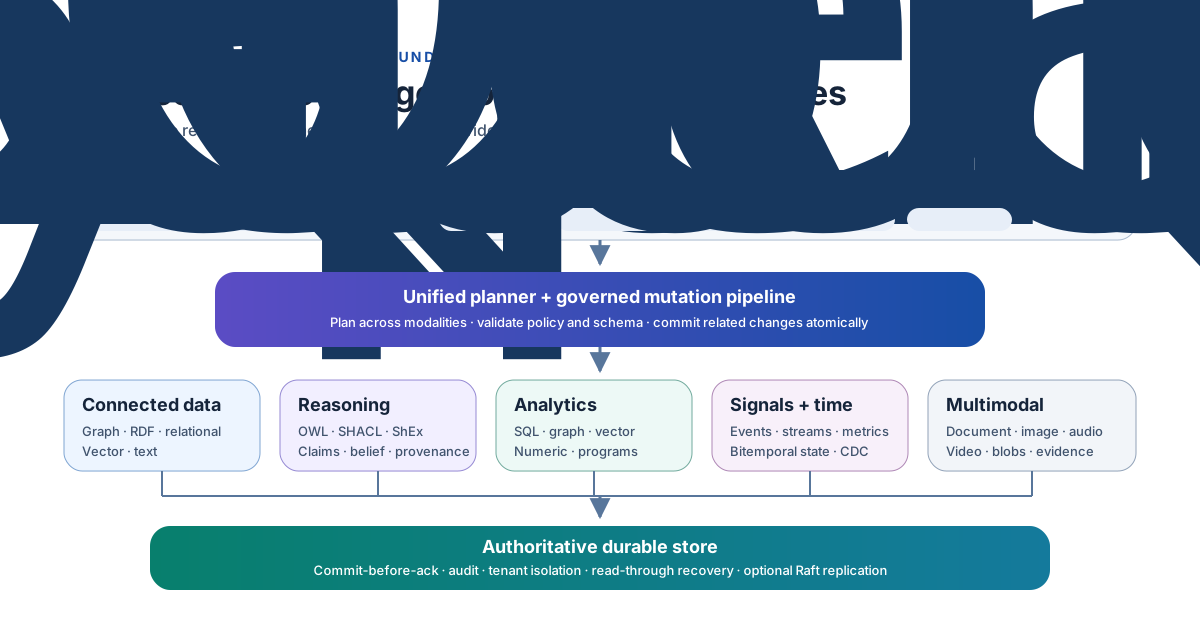
The main build provides the connected data, semantic reasoning, analytical, temporal, and multimodal surfaces shown above. Compatibility is published per operation: the capability matrix explains supported behavior, while the generated method ledger records exact authority, durability, audit, CDC, and transaction properties.
Capability truth is part of the product
Status is generated from the same method contracts the engine serves. Check current status and the capability matrix before selecting an interface or deployment shape.
Where this engine fits
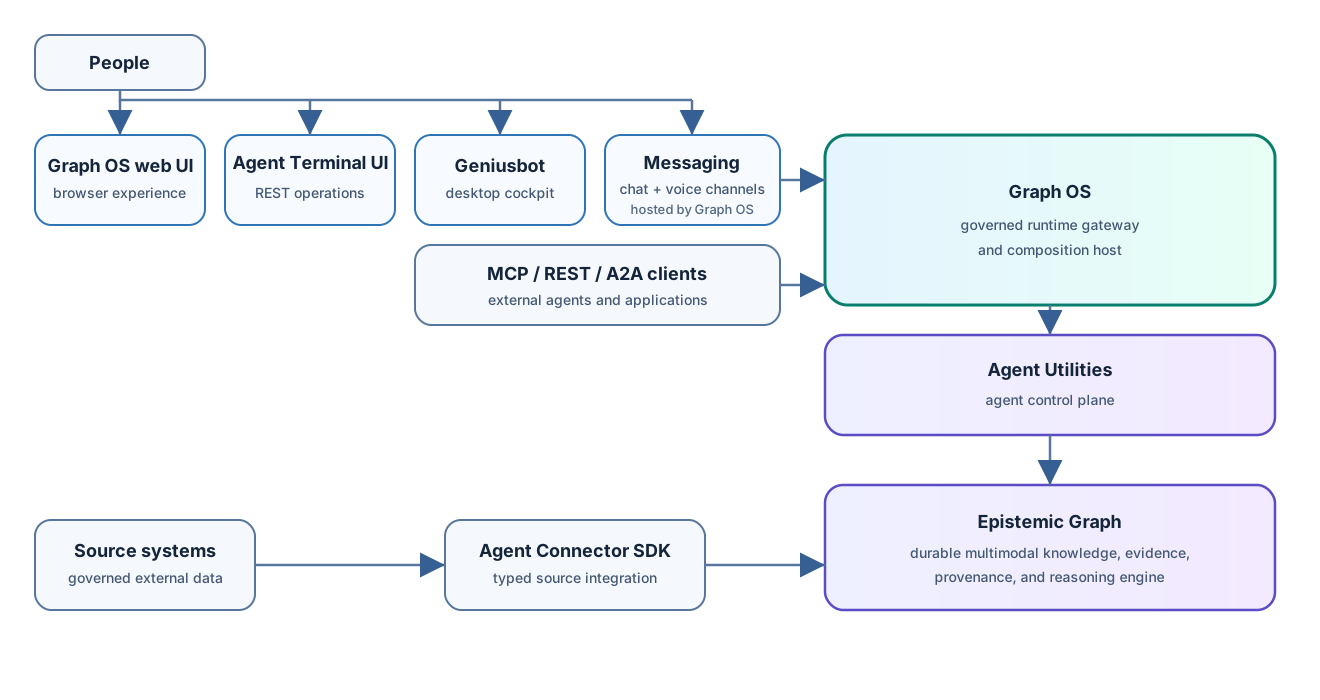
Explore the live architecture.
- Enter through Arbora MCP, REST, A2A, identity, policy, and the hosted WebUI share one public door.
- Run with agent-utilities Agents, workflows, skills, evaluation, and control-plane decisions run above the database.
- Commit in Medulla State, schema, evidence, provenance, and outcomes become durable under one transaction boundary.
- Synchronize through connectors SDK-based connectors exchange governed records with external source systems.
Choose an interface
| Goal | Start here |
|---|---|
| Add or query graph records from Python | Python and native clients |
| Query connected knowledge | UQL, Cypher, or GraphQL |
| Work with RDF and ontologies | RDF, SPARQL, OWL, and SHACL |
| Run relational analytics | SQL and PostgreSQL wire |
| Search vectors, text, and memory | Memory interfaces and vector search |
| Ingest documents and media | Governed modality serving |
| Operate a durable service | Standalone deployment and operations |
Run the operator's first graph
The release wheel includes the in-process engine binding, so the shortest path needs no server, port, certificate, or background process:
python -m pip install epistemic-graph
python - <<'PY'
import msgpack
from epistemic_graph.engine import Engine

engine = Engine(persist_dir=":memory:")
engine.create_graph("demo")
engine.add_node("demo", "node:hello", msgpack.packb({"kind": "Greeting"}, use_bin_type=True))
print(engine.has_node("demo", "node:hello"), engine.node_count("demo"))
PY
Expected output: True 1. This explicit :memory: mode is ephemeral. Continue
to the local guide for the annotated example, or go directly
to Deploy for durable service, TLS, and cluster
configuration.
Specification delivery
Open the specification dashboard
for documented specifications, separate requirement status, delivery evidence,
and open pull request and issue snapshots. It refreshes on pushes to main.
Completion requires recorded delivery and acceptance; a merged requirement does
not complete its parent specification. Burndown, source-landed velocity, and
the delivery timeline use bounded first-parent observations of tracked status
files. Commit dates are observation times; release and deployment dates remain
unknown without explicit evidence.